Obsidian
Obsidian serves as a personal knowledge base: research notes, article drafts, project tracking, before content gets finalized and published through Notion. Files stay in local Markdown, with no proprietary lock-in, which makes it a durable foundation for years of notes.
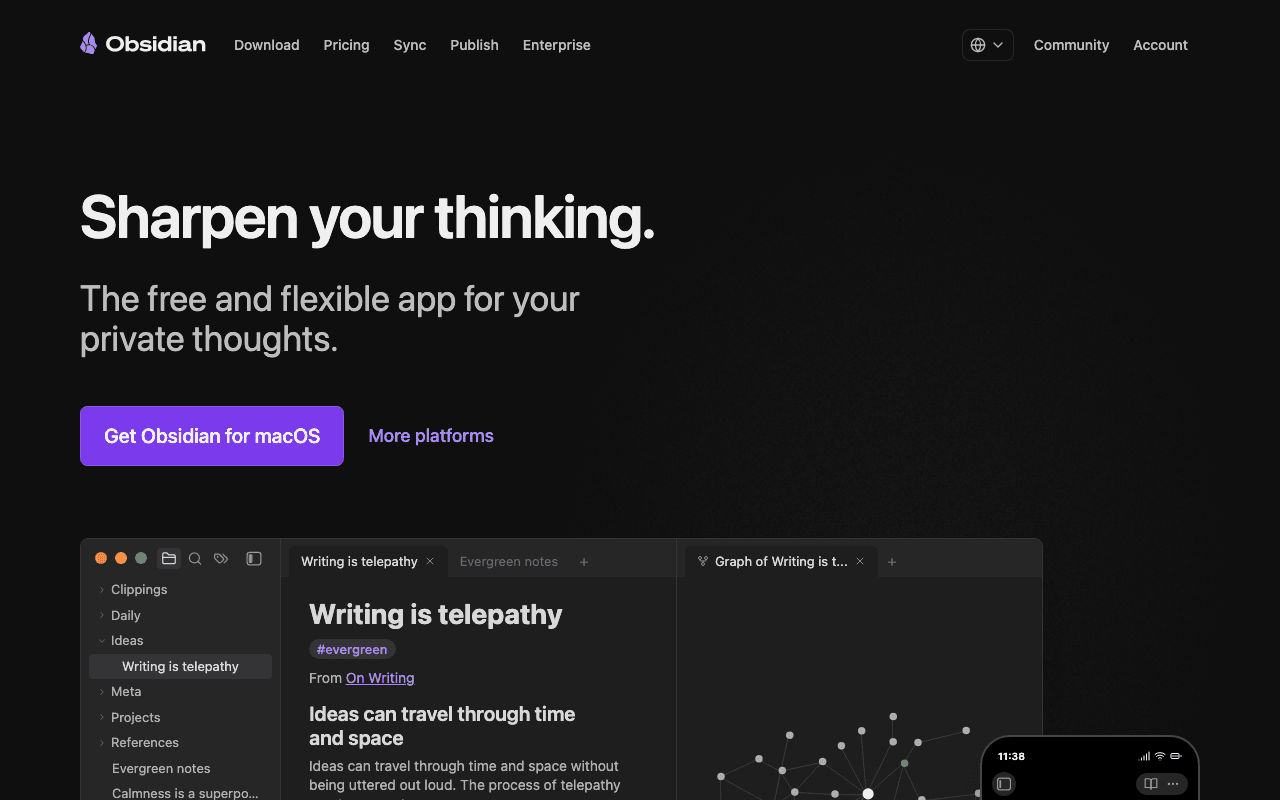
Key advantages
- Local Markdown files, no proprietary lock-in
- A very rich community plugin ecosystem
- Works offline, data stays on the machine
Who it's for, and why
Anyone who wants a durable personal knowledge base, in local files rather than locked into a proprietary cloud service.
- Taking research and monitoring notes
- Article drafts and outlines before publishing
- A linked knowledge base (bidirectional links between notes)
Getting started
- 1Download the universal installer for macOS, Windows or Linux from obsidian.md/download.
- 2On Linux, native packages also exist: Snap, AppImage or .deb depending on the distribution.
- 3Open a local folder (or create a new one) as your first vault: notes stay as Markdown files on the machine.
- 4Explore the community plugin catalog via Settings → Community plugins to extend functionality.
Things to watch out for
- The core app is proprietary (closed source), despite storing content in open Markdown files: it's not strictly an open-source project.
- Free for any use including commercial, but the official cloud sync (Obsidian Sync) is a separate paid service.
- No native real-time collaboration like Google Docs: built for personal use first and foremost.
Frequently asked questions
Is Obsidian free for professional use?
Yes, the maker explicitly states the app is free for any use, personal or commercial. Optional paid licenses (Catalyst, Commercial) exist to support development, without being mandatory.
Is the source code open?
No, the core app is proprietary. Only the release-tracking and community documentation repository is public, not the engine itself.
Are my notes locked into a proprietary format?
No, it's the opposite: notes are plain local Markdown files, readable and usable without Obsidian if needed.
Worth exploring too
Notion MCP Server
Notion's official MCP server: search, read and write pages directly from an AI agent.
Caveman
A Claude Code skill that compresses agent output into terse, filler-free prose to save tokens: "why use many token when few do trick."
edge-tts
A free Python tool that uses Microsoft Edge's text-to-speech engine, with no API key or subscription.