edge-tts
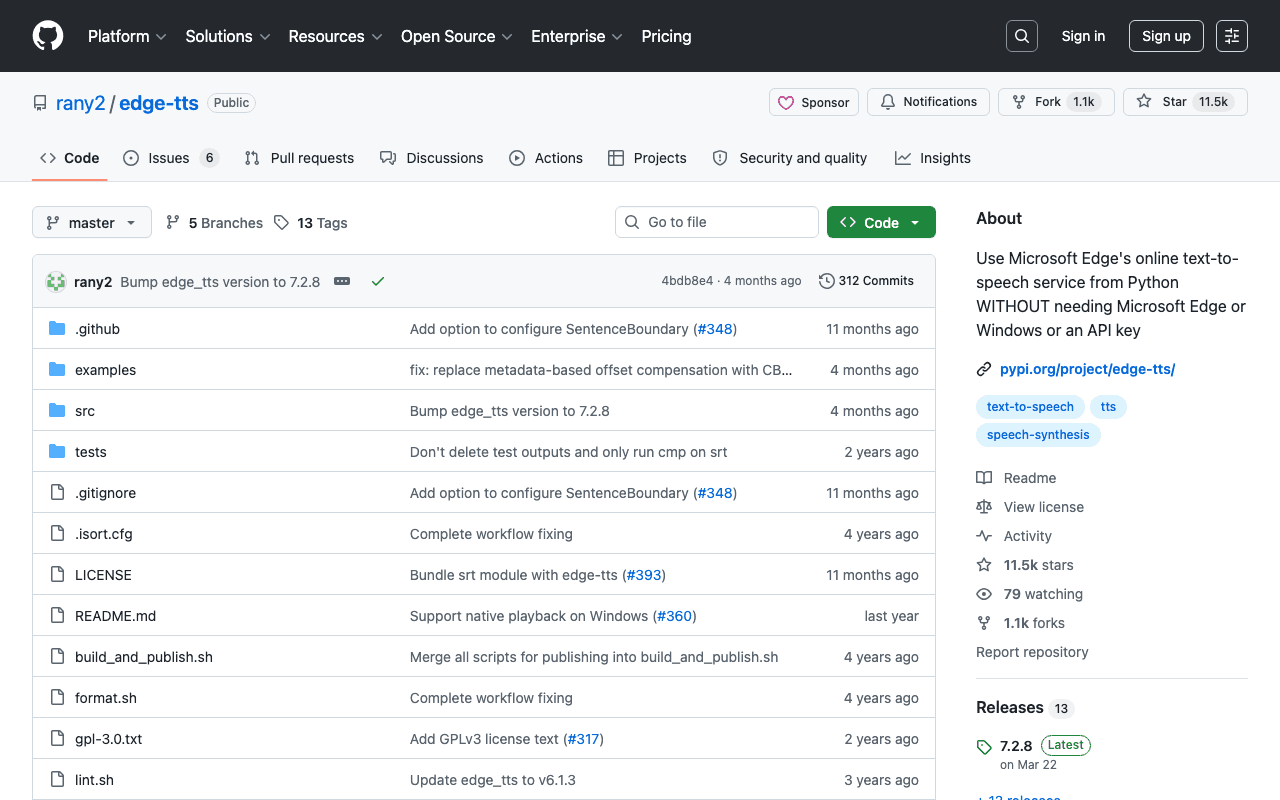
Every audio narration on this blog is generated with edge-tts: it uses the same text-to-speech engine as Microsoft Edge, accessible for free from the command line, with no account and no per-minute billing. It's the option chosen after comparing paid APIs (Google Cloud TTS, ElevenLabs): quality good enough for article narration, zero cost, no risk of a surprise bill.
Key advantages
- Entirely free, no API key required
- Over 300 voices across dozens of languages
- Decent quality for narration, not just robotic-sounding text
Who it's for, and why
Content creators who want an audio version of their articles without a dedicated text-to-speech budget.
- Audio narration of blog articles
- Quick voiceover prototyping before choosing a paid tool
- Generating audio content in multiple languages
Getting started
- 1Install via pip: `pip install edge-tts` (or `pipx install edge-tts` for an isolated command-line install).
- 2Generate audio: `edge-tts --text "Hello world" --voice en-US-AriaNeural --write-media output.mp3`.
- 3For instant playback with subtitles: `edge-playback --text "..."` (requires the `mpv` player, except on Windows).
Things to watch out for
- Relies on Microsoft Edge's text-to-speech engine through an unofficial, undocumented API: a change on Microsoft's side could break it without notice.
- No service guarantee or support: it's a free community project, not a commercial API with an SLA.
- Decent quality for article narration, but below premium paid voices (ElevenLabs and similar) on fine expressiveness.
Frequently asked questions
Is edge-tts really free, with no limits?
Yes, no API key or billing: it reuses Microsoft Edge's public voice engine. The trade-off is no guarantee of long-term service continuity.
How many voices and languages are available?
Several hundred voices covering dozens of languages, including several good-quality English and other-language voices.
Can it be used in production for a commercial product?
Nothing technically prevents it, but relying on an unofficial API for a critical commercial product is a risk to knowingly accept; for editorial use like blog narration, the trade-off is reasonable.
Worth exploring too
Google Cloud Text-to-Speech
Google's official text-to-speech API, with a generous free tier and Neural2/Studio voices noticeably more natural than a typical free engine.
Playwright
Microsoft's browser testing and automation framework, used here to capture real screenshots.
Obsidian
A local Markdown note-taking app, with a very active community plugin ecosystem.